PluraMath: Extending Mathematical Reasoning Evaluation Beyond High-Resource Languages

Preprint ·2026

Daryna Dementieva1,2,* · Nikolay Babakov4 · Kathy Hämmerl1,2 · Ilseyar Alimova5 · Jindřich Libovický6 · Shu Okabe1,2 · Miras Baisbay7 · Lukas Edman1,2 · Abrorkhon Inomkhujaev1 · Antonia Karamolegkou8 · Mateusz Lango6 · Volkan Özer1,2 · Nikola Selic1 · Subhankar Swain9 · Tsedeniya Kinfe Temesgen1,2 · Galit Bary Weisberg10 · Alexander Fraser1,2,3

1Technical University of Munich (TUM)   2Munich Center for Machine Learning (MCML)   3Munich Data Science Institute (MDSI)   4Independent Researcher   5Applied AI Institute   6Charles University   7Nazarbayev University   8Inria   9Indian Institute of Technology, Kharagpur (IIT Kharagpur)   10German University of Digital Science

* Correspondence: daryna.dementieva@tum.de

Paper Code 🤗 Dataset BibTeX

Can LLMs reason about mathematics in Українськаuk ?

18
languages
6
language families
9,000
validated problems
27
LLMs benchmarked
Abstract.

Mathematical reasoning has become a central task for evaluating and tuning reasoning Large Language Models (LLMs), yet existing benchmarks remain heavily biased toward high-resource languages, with English and Chinese dominating both pre-training corpora and evaluation suites. The recently released PolyMath dataset represents a significant step forward, yet its coverage is still limited to 18 only high-resource languages.

To address this gap, we introduce PluraMath, an extension of PolyMath to 18 additional underrepresented languages spanning 6 language families — ranging from mid-resource to extreme low-resource settings. We constructed the dataset through a human-curated pipeline, where native speakers thoroughly validated pre-computed translations. Using PluraMath, we benchmark 27 reasoning LLMs across four model scales — small, mid-size, large, and closed-source ensembles — probing multilingual mathematical reasoning under diverse linguistic conditions.

Our fine-grained analysis confirms a persistent gap in mathematical reasoning performance between high-resource and underrepresented languages, with stronger results largely associated with better instruction-following ability. We fully open-source our dataset, data acquisition pipeline, and evaluation framework, with the goal of lowering the barrier to multilingual benchmark development for underrepresented communities.

PluraMath construction: PolyMath high-resource base languages (EN, RU, ES, DE), four levels of task difficulty, and the 18-language extension
PluraMath extends PolyMath's four difficulty levels — from K-12 word problems to Olympiad & frontier math — to 18 underrepresented languages.

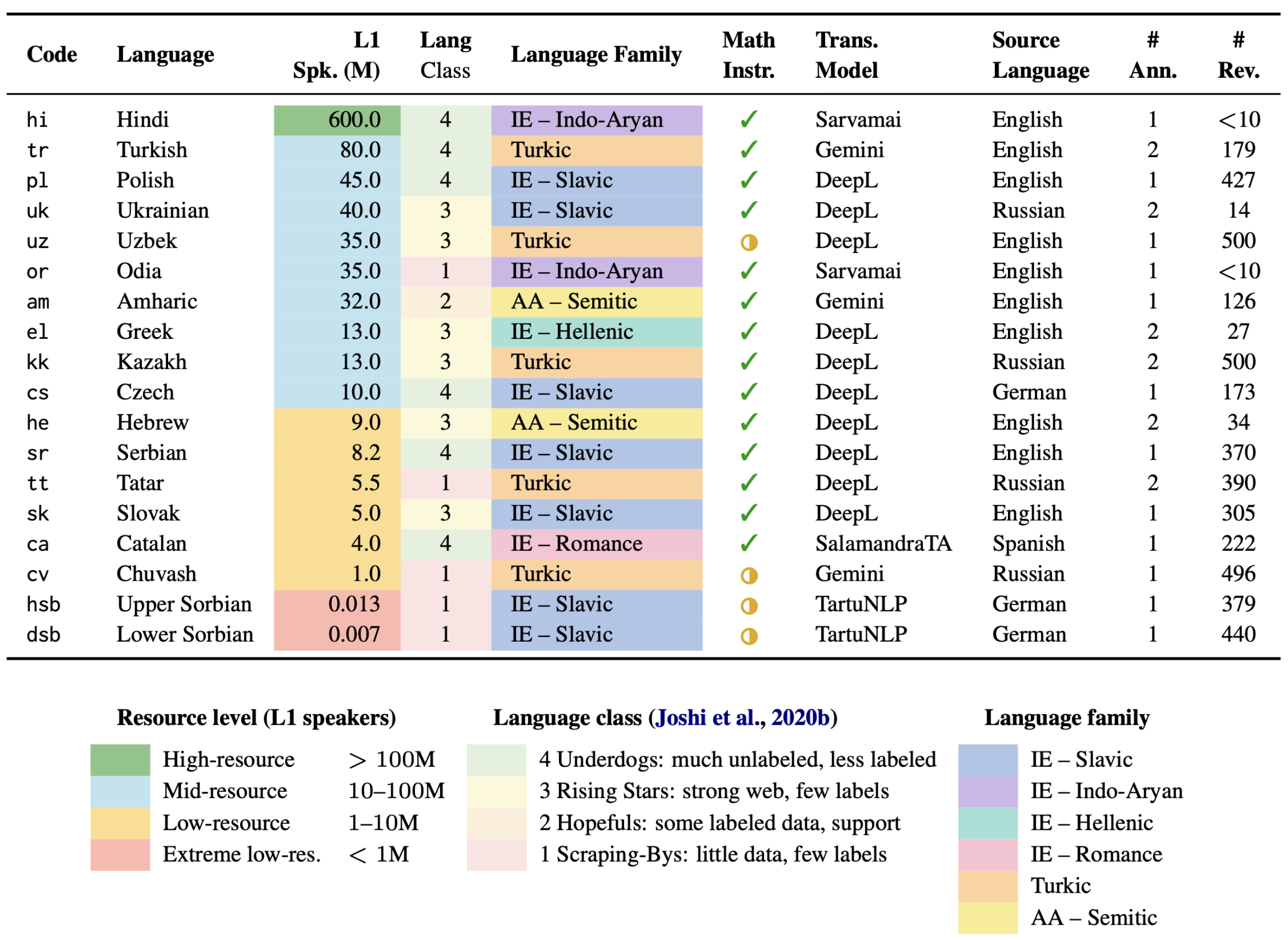
18 languages, from 600 M speakers to 7 k.

Coverage spans Indo-European (Slavic, Indo-Aryan, Hellenic, Romance), Turkic, and Afro-Asiatic (Semitic) families — deliberately including languages with tiny speaker populations and minimal web presence, such as Upper and Lower Sorbian.

हिन्दीHindi · IE-Indo-Aryan hi
TürkçeTurkish · Turkic tr
PolskiPolish · IE-Slavic pl
УкраїнськаUkrainian · IE-Slavic uk
OʻzbekchaUzbek · Turkic uz
ଓଡ଼ିଆOdia · IE-Indo-Aryan or
አማርኛAmharic · AA-Semitic am
ΕλληνικάGreek · IE-Hellenic el
ҚазақшаKazakh · Turkic kk
ČeštinaCzech · IE-Slavic cs
עבריתHebrew · AA-Semitic he
СрпскиSerbian · IE-Slavic sr
ТатарчаTatar · Turkic tt
SlovenčinaSlovak · IE-Slavic sk
CatalàCatalan · IE-Romance ca
ЧӑвашлаChuvash · Turkic cv
HornjoserbšćinaUpper Sorbian · IE-Slavic hsb
DolnoserbšćinaLower Sorbian · IE-Slavic dsb

A reusable human-in-the-loop pipeline.

Each language contains 500 problems (125 per difficulty level), inherited from PolyMath and translated through three stages. The full pipeline — scripts, annotation interface, and written guidelines — is open-sourced so that any community can extend the benchmark to their language.

STAGE 1

Automatic first draft

The strongest available translation system per language produces initial drafts: DeepL, Gemini, Sarvamai, SalamandraTA, or TartuNLP — from English, Russian, German, or Spanish sources.

STAGE 2

Native-speaker verification

Native speakers thoroughly validate and correct every translation. All annotators were fully informed about the goals of the project and worked with written instructions.

STAGE 3

LaTeX & error checking

Automated and manual checks of formula integrity, followed by a final error analysis, guarantee that mathematical content survives translation intact.

Results: the resource gap persists.

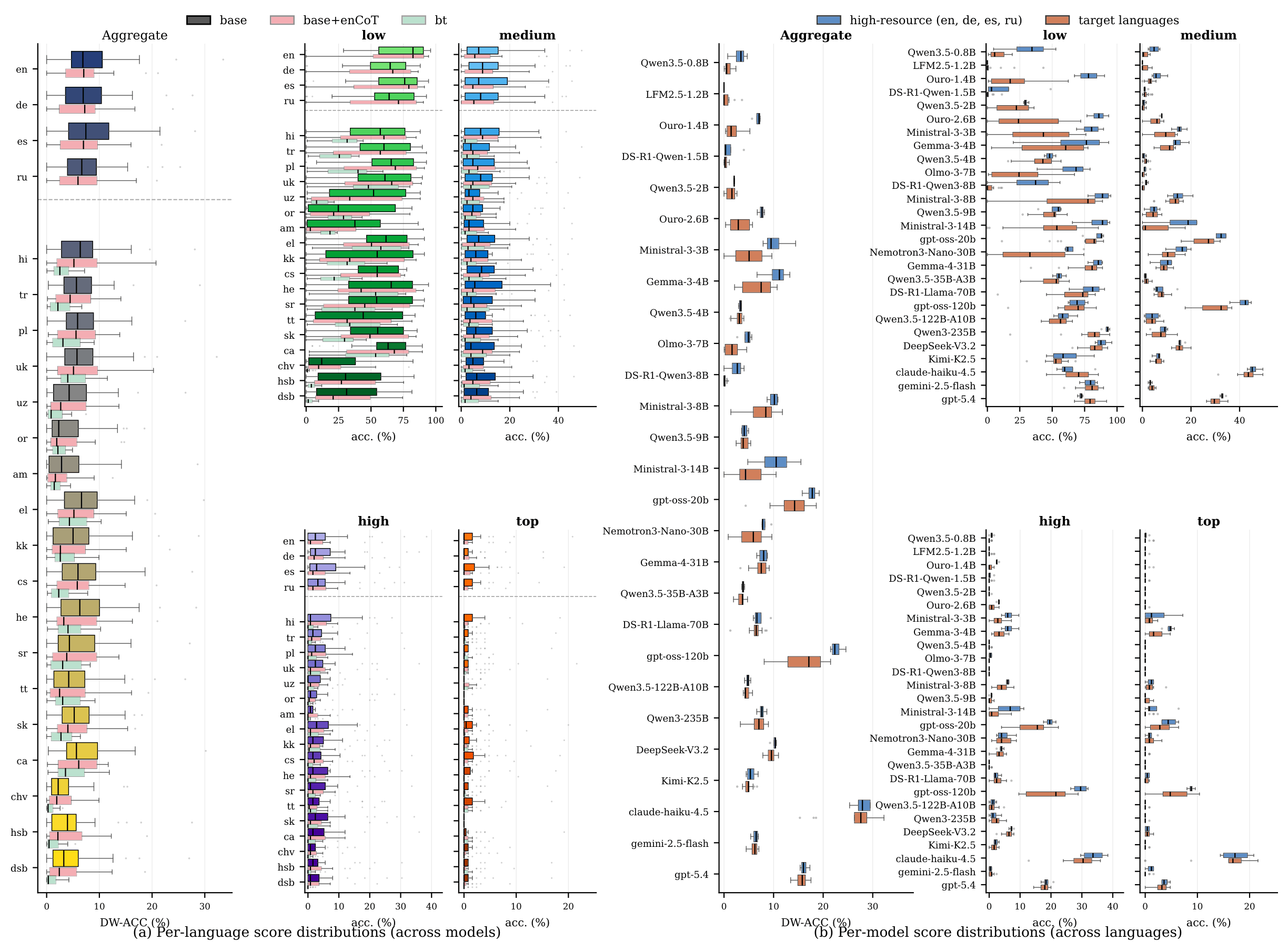
We evaluate 27 reasoning LLMs with difficulty-weighted accuracy (DW-Acc), alongside \boxed{} format compliance, generation length, and the dominant answer language. Language resource class strongly correlates with benchmark ranking — Spearman ρ = 0.646 (p = 0.0038).

Per-model DW-ACC distributions across languages: high-resource (en, de, es, ru) vs the 18 PluraMath target languages, aggregated and per difficulty level.
Per-model score distributions across languages — high-resource (en, de, es, ru) vs. the 18 PluraMath target languages, aggregate and per difficulty level. Small open models fluctuate wildly across language groups; recent large and proprietary models remain far more stable.

Key findings

+2.15 The gap is systematic

Average high-resource → target DW-Acc gap is +2.15 points, up to +4.86 for Chuvash and Amharic. Greek and Polish are nearly on par (+0.67).

🧊 Frontier models are more stable

Small open models fluctuate wildly across language groups; Claude-Haiku-4.5 and GPT-5.4 stay remarkably stable across all 22 evaluated languages.

r=−0.16 Longer ≠ better

The best models produce correct answers with substantially shorter reasoning traces; output length correlates negatively with translation quality (chrF++).

r=+0.45 Reliability transfers

Translation quality moderately correlates with math accuracy (+0.45) and instruction following (+0.35) — models that follow task requirements do so across tasks.

🔁 Reasoning quality degrades

Human evaluation across 6 criteria shows frequent mid-reasoning switches to English, less coherent derivations, and reasoning left unfinished within the token budget.

🪄 Prompting tricks don't close it

En-CoT and back-translation prompting yield only limited improvements for most models — the gap reflects capability, not prompt design.

Full results — base prompting, aggregated across difficulty levels

Each cell reports DW-Acc (%). Best and second-best per column are highlighted. After each language block: macro-average, mean ± std generation length (tokens), and dominant answer language (tl = target language, en = English).

Model en de ru es AvgLenLang hi tr pl uk uz or am el kk cs he sr tt sk ca cv hsb dsb AvgLenLang
Open-weight — small (≤4B)
Qwen3.5-0.8B 4.7 3.1 0.7 3.7 3.1 2288±1432 tl 0.4 0.4 0.5 1.4 0.1 1.2 0.1 1.7 0.4 1.8 2.4 0.5 0.7 1.3 0.3 0.3 0.4 0.8 0.8 2238±780 en
LFM2.5-1.2B 0.0 0.0 0.0 0.0 0.0 3485±1213 en 0.0 1.0 3.6 0.0 0.5 0.0 0.9 0.0 0.0 0.0 0.0 1.0 0.0 0.0 2.1 0.0 0.0 0.0 0.5 2660±835 en
Ouro-1.4B 7.3 6.9 5.7 7.2 6.8 1477±532 tl 2.9 3.3 5.2 1.4 0.5 0.4 0.6 2.1 0.4 2.6 1.7 1.4 1.4 2.3 4.8 0.3 0.7 1.0 1.8 1608±372 en
R1-Distill-Qwen-1.5B 4.0 0.2 0.2 0.5 1.2 2691±1058 en 0.1 0.3 0.1 0.0 0.5 0.1 1.0 0.2 0.2 1.1 0.0 0.9 0.5 0.1 0.5 0.8 0.2 0.1 0.4 3032±832 en
Qwen3.5-2B 2.0 2.1 2.0 2.1 2.1 1932±151 tl 0.5 1.8 2.6 2.3 1.4 0.7 0.3 2.3 1.1 2.1 2.0 2.1 0.8 2.2 2.3 0.0 0.4 0.1 1.4 1982±146 tl
Ouro-2.6B 8.2 6.7 7.5 7.8 7.5 1587±544 en 4.4 5.7 0.9 5.8 1.8 1.8 0.3 5.5 0.6 5.3 3.0 4.2 1.2 4.7 5.7 1.1 2.7 2.0 3.1 1600±453 en
Ministral-3-3B 9.1 7.9 9.9 14.5 10.3 1421±761 tl 7.8 4.0 8.4 8.7 1.2 1.3 0.0 8.2 6.1 7.3 7.2 2.2 3.8 6.7 9.7 2.2 3.9 2.8 5.1 1634±667 en
Gemma-3-4B 13.3 10.8 6.7 11.6 10.6 1262±616 tl 8.4 6.4 9.0 10.5 7.6 2.5 5.3 10.7 3.6 9.5 7.4 9.9 4.1 8.2 10.3 2.1 3.2 3.3 6.8 1512±841 tl
Qwen3.5-4B 2.9 3.5 3.5 3.2 3.3 1912±188 tl 2.6 3.1 3.8 3.1 3.0 1.8 2.8 3.6 3.2 3.1 4.0 3.6 3.0 3.7 3.7 1.4 1.2 1.4 2.9 1942±187 tl
Open-weight — mid-size
OLMo-3-7B-Think 5.1 4.7 2.7 5.6 4.5 1891±318 en 1.8 3.3 4.6 3.8 0.1 1.4 0.1 2.8 1.3 2.5 2.4 0.2 0.3 2.3 4.0 0.1 0.5 0.2 1.8 1960±187 en
R1-0528-Qwen3-8B 4.1 3.1 0.0 2.2 2.4 3181±489 tl 0.0 0.6 0.7 0.1 0.3 0.0 0.0 0.0 0.0 0.4 0.0 0.0 0.0 0.2 0.8 0.0 0.1 0.1 0.2 3177±429 en
Ministral-3-8B 10.7 8.7 9.6 10.9 10.0 1514±769 en 9.3 9.7 11.8 9.4 8.1 1.5 2.7 9.3 5.9 8.7 10.5 9.7 7.0 7.9 9.7 1.4 5.7 5.9 7.5 1544±747 en
Qwen3.5-9B 3.7 3.6 5.0 4.5 4.2 3617±782 tl 4.9 3.5 3.7 5.4 4.1 3.4 3.4 5.0 5.1 4.1 5.2 3.7 4.6 4.7 3.6 3.3 2.5 2.5 4.0 3083±581 tl
Ministral-3-14B 9.4 11.7 4.8 15.5 10.3 1559±663 tl 8.5 4.7 5.9 3.9 3.5 0.1 0.0 9.1 8.0 9.3 10.5 3.3 2.3 3.1 4.4 2.2 5.5 4.3 4.9 1810±549 en
gpt-oss-20b 17.6 15.8 19.2 18.0 17.7 2847±1665 en 15.8 12.4 12.1 18.6 10.2 15.2 9.3 16.7 16.0 17.3 16.6 11.8 16.3 14.9 12.7 4.4 13.6 12.6 13.7 2585±1277 en
Nemotron3-Nano-30B 9.5 7.7 7.8 7.7 8.2 2207±1796 en 7.4 7.9 8.6 6.5 3.9 0.9 2.0 8.9 4.3 7.6 9.7 6.6 4.3 5.3 6.6 1.9 3.5 2.5 5.5 1608±1461 en
Gemma-4-31B 6.6 7.4 8.7 8.6 7.8 1664±534 tl 8.4 9.1 8.7 8.5 7.5 6.4 7.6 7.1 7.6 6.9 8.5 8.6 6.8 7.4 7.6 3.3 5.3 5.0 7.2 1724±485 tl
Qwen3.5-35B-A3B 3.7 3.6 3.9 4.2 3.9 1880±241 tl 2.9 3.7 3.8 4.4 4.7 2.3 4.1 4.1 3.7 3.2 3.8 3.7 3.3 3.8 3.8 1.9 2.8 2.8 3.5 1919±224 tl
Open-weight — large
R1-Distill-Llama-70B 6.8 5.9 9.4 6.5 7.2 1678±667 tl 6.7 6.5 7.7 8.6 6.2 5.2 1.3 7.4 6.8 6.4 6.3 8.3 6.9 6.6 6.1 6.6 5.1 6.1 6.4 1703±626 en
gpt-oss-120b 24.6 22.7 22.0 21.5 22.7 2590±1607 tl 19.6 12.8 12.2 21.0 13.6 14.6 12.9 19.1 21.3 18.7 21.5 13.0 20.5 16.6 12.5 8.1 17.9 17.6 16.3 2328±1267 en
Qwen3.5-122B-A10B 4.7 4.9 5.4 4.2 4.8 3447±971 tl 4.0 4.2 3.9 5.1 4.3 5.2 4.1 5.8 4.9 4.3 4.8 4.3 5.0 5.1 4.4 3.9 4.2 4.3 4.5 2991±666 tl
Qwen3-235B-A22B 6.6 7.6 8.6 7.7 7.6 3269±1264 tl 7.0 6.1 5.8 8.1 5.5 6.3 4.5 7.6 8.0 7.1 9.0 6.2 8.2 8.0 6.2 3.3 7.9 7.2 6.8 2888±846 tl
DeepSeek-V3.2 10.6 10.4 9.3 10.3 10.1 1751±675 tl 10.0 9.8 11.0 8.8 8.5 9.2 8.7 10.3 8.9 9.4 10.4 10.3 7.8 10.1 9.7 9.0 9.2 9.8 9.5 1806±605 tl
Kimi-K2.5 6.9 4.9 4.5 5.8 5.5 1804±580 tl 3.7 6.7 5.9 5.2 4.4 5.0 4.4 6.1 4.9 4.0 5.0 5.0 3.9 5.1 4.9 2.7 4.9 5.0 4.8 1878±499 tl
Closed-source
Claude-Haiku-4.5 33.5 27.7 25.3 28.2 28.7 848±401 tl 28.1 29.1 26.3 32.3 26.3 18.6 28.6 29.8 28.9 27.6 28.4 27.1 26.3 18.1 30.2 15.3 27.6 27.0 26.4 934±414 tl
Gemini-2.5-Flash 6.2 6.7 5.4 6.9 6.3 3636±4226 tl 6.0 6.7 6.9 6.5 7.0 5.7 6.9 5.3 6.8 5.5 6.3 6.3 6.2 6.1 5.7 6.3 5.3 4.5 6.1 3891±4364 tl
GPT-5.4 17.3 16.3 15.4 15.8 16.2 317±249 tl 16.1 16.5 16.2 16.5 17.3 13.4 14.2 15.3 16.3 15.6 17.5 16.0 14.8 14.5 16.8 14.7 15.2 15.0 15.7 371±261 tl

Per-difficulty-level results, prompting ablations (base / En-CoT / back-translation), API costs, and reasoning-length analyses are provided in the paper appendices.

Do translation capabilities drive multilingual reasoning? Partly.

To test whether gains in reasoning are tied to underlying translation ability, we run a case study on a subset of models — in both reasoning and non-thinking modes — on translation tasks from the FLORES+ dev split and the LLMs with Limited Resources shared task, and correlate chrF++ translation quality with every axis of our math benchmark.

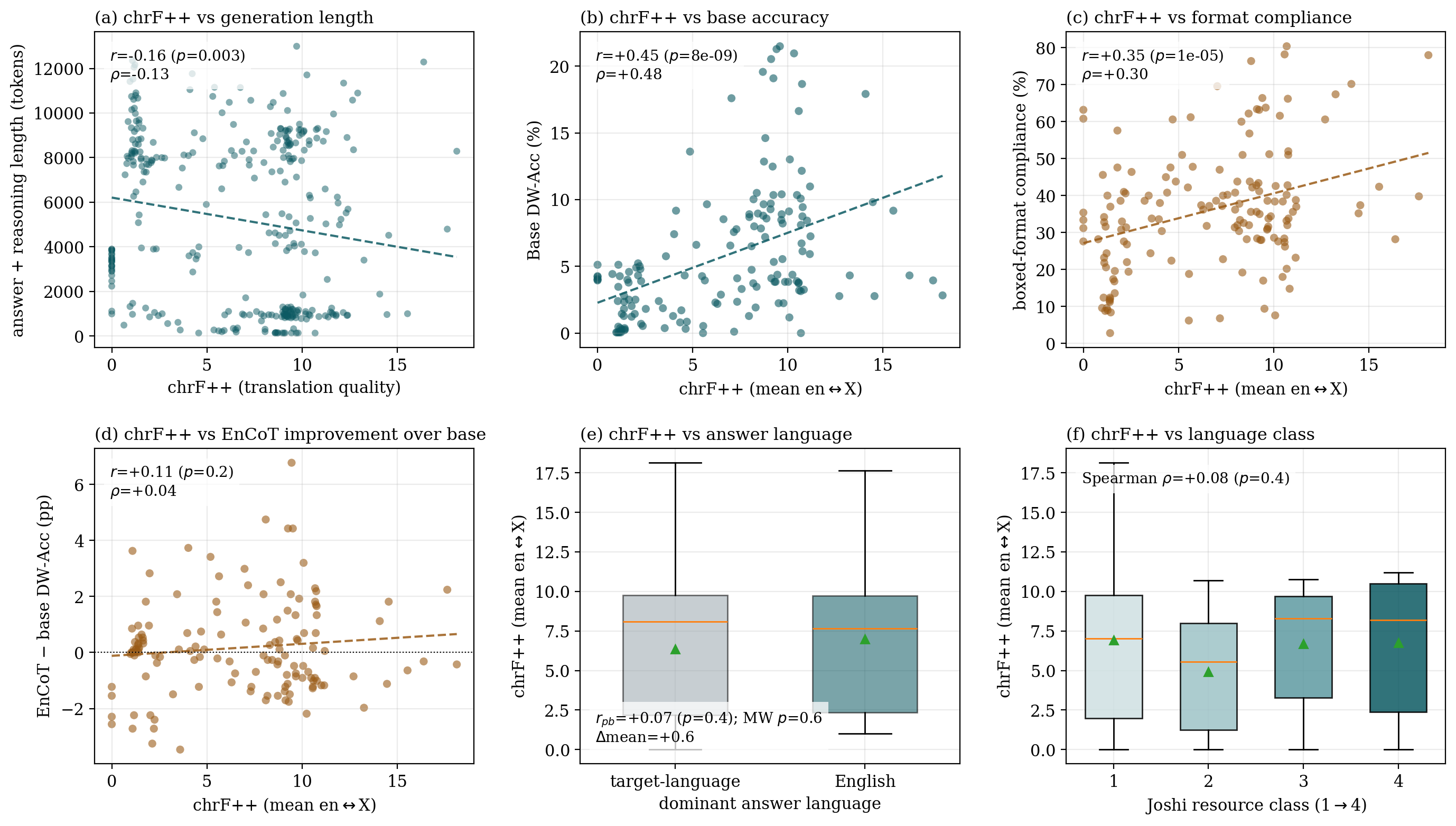
Six-panel correlation analysis: chrF++ vs generation length, base accuracy, format compliance, En-CoT improvement, answer language, and language class.
chrF++ translation quality vs. (a) generation length, (b) math accuracy, (c) format compliance, (d) En-CoT gains, (e) answer language, and (f) language resource class.
r = +0.45
Math task accuracy
p < 10⁻⁸ · moderate
r = +0.35
Instruction following
p < 10⁻⁴ · moderate
r = −0.16
Output length
p < 0.01 · negative
r = +0.11
En-CoT prompting gains
p = 0.21 · none
rpb = +0.07
Answering in English vs. target
p = 0.36 · none
ρ = +0.08
Language resource class
p = 0.36 · none
Verdict: translation ability helps — but mostly as a proxy for general task reliability. Models that translate well also follow math task requirements more faithfully (moderate positive correlations), while longer reasoning traces do not improve translation quality (negative correlation). Crucially, En-CoT gains, the choice to answer in English, and even language resource class show little correlation with translation capability — indicating that other cross-lingual reasoning mechanisms play a larger role than raw translation skill.

BibTeX.

@misc{dementieva2026pluramath,
  title         = {PluraMath: Extending Mathematical Reasoning Evaluation Beyond High-Resource Languages},
  author        = {Daryna Dementieva and Nikolay Babakov and Kathy H{\"a}mmerl and
                   Ilseyar Alimova and Jind{\v{r}}ich Libovick{\'y} and
                   Shu Okabe and Miras Baisbay and Lukas Edman and
                   Abrorkhon Inomkhujaev and Antonia Karamolegkou and
                   Mateusz Lango and Volkan {\"O}zer and Nikola Selic and
                   Subhankar Swain and Tsedeniya Kinfe Temesgen and
                   Galit Bary Weisberg and Alexander Fraser},
  year          = {2026},
  eprint        = {2607.05992},
  archivePrefix = {arXiv},
  primaryClass  = {cs.CL},
  doi           = {10.48550/arXiv.2607.05992},
  url           = {https://arxiv.org/abs/2607.05992},
}

Please also cite the original PolyMath benchmark (Wang et al., 2025).

Language contributors.

HindiSubhankar Swain
TurkishVolkan Özer
PolishMateusz Lango
UkrainianDaryna Dementieva
UzbekAbrorkhon Inomkhujaev
OdiaSubhankar Swain
AmharicTsedeniya Kinfe Temesgen
GreekAntonia Karamolegkou
KazakhMiras Baisbay
CzechJindřich Libovický
HebrewGalit Bary Weisberg
SerbianNikola Selic
TatarIlseyar Alimova
SlovakŠimon Kapusta
CatalanAINA team
ChuvashAlexander Antonov
Upper SorbianWITAJ
Lower SorbianWITAJ

Acknowledgements

We express our enormous gratitude to all annotators and supporters of the project. Firstly, we are grateful for our collaboration with the WITAJ-Sprachzentrum and thank Anita Hendrichowa, Marko Měškank, and Kryštof Peršín, in particular, for their annotations of the Upper Sorbian and Lower Sorbian splits. Secondly, the translation to Catalan has been promoted by the Aina Project. We are also grateful to Šimon Kapusta for his help in checking the Slovak translations. The work of the authors on the Czech and Slovak splits was supported by the project CZ.02.01.01/00/23_020/0008518 of the Czech Ministry of Education, Youth and Sports. Finally, we warmly thank Alexander Antonov for the annotation of the Chuvash split.

This work was co-funded by the European Union (ERC, EPICAL, 101141712 and ERC, NG-NLG, 101039303). Views and opinions expressed are however those of the author(s) only and do not necessarily reflect those of the European Union or the European Research Council. Neither the European Union nor the granting authority can be held responsible for them.

PluraMath
PluraMath · GitHub · 🤗 Dataset · arXiv
License: Apache 2.0. Built for underrepresented language communities.